
Verifying an overseas supplier before payment should answer three questions: Is the contracting party the business it claims to be? Can it supply the agreed product? What documented recourse exists if quality, quantity or delivery differs from the agreement? A polished website, detailed catalogue or certificate image does not answer these questions on its own.
This checklist is intended for commercial sourcing from Türkiye, China, the UAE and other countries for delivery to Iran. Match the depth of investigation to the order value, product sensitivity and relationship history. Verification cannot eliminate risk, but it can reveal important uncertainties before money is committed.
1. Establish the identity of the contracting party
Request the full registered name in the local language, registration number, address, official contact details and authorised signatory. A catalogue brand may differ from the legal entity issuing the quotation. That difference needs a documented explanation.
Compare the names on the quotation, contract, invoice and payment instructions in one record. If a trading company signs the contract, record the manufacturer and the trading company’s quality responsibilities. Retain the date and source of each document.
2. Check registration through an independent route
Do not rely only on a link or screenshot supplied by the seller. Locate the official authority independently and match the record to the exact entity. Search functions and sign in requirements vary between systems.
| Country | Source | Initial purpose |
|---|---|---|
| Türkiye | MERSİS and the Trade Registry Gazette | Match registration information and notices |
| China | Government guidance linking to GSXT | Locate the official enterprise credit information system |
| UAE | Official business licence verification portal | Find the relevant licensing authority |
| India | DGFT services | Check exporter IEC related information |
For a Chinese company, obtain its registered Chinese name and the identifier on its business licence; an English marketing name may not be enough. For a UAE entity, establish the issuing authority. For a Turkish supplier, review relevant name or representative changes in published notices. Registration clarifies identity; production quality and financial strength require separate evidence.
3. Test actual supply capability with product evidence
If the seller is a manufacturer, ask about equipment relevant to your product, subcontracted stages, available capacity and incoming material controls. If it is a distributor, request evidence of stock access and the supply chain. Different roles can work; undisclosed roles create uncertainty.
- Ask the supplier to explain how your particular product is made or prepared.
- Review complex drawings or samples with a technical representative.
- Use a live video call to see relevant areas, without treating it as a substitute for a necessary visit.
- Verify representation claims with the manufacturer through independently obtained contact details.
- Where customer references are available, check delivery experience with permission and without requesting confidential information.
An inspection report is useful when it identifies the company, location, date, scope and limitations. A report about a different factory or unrelated product should not improve the score for your purchase.
4. Distinguish certification from product acceptance
ISO states that it does not issue certificates. Verify certification through the issuer or the verification routes it identifies. Check the holder, number, scope and dates; follow up an unsuccessful database search with the issuer before drawing a conclusion.
ISO 9001 concerns a quality management system. Its presence does not demonstrate that your specific model or shipment has passed the required product testing. Request a relevant report identifying the model, test method and results for any technical claim.
5. Turn the sample into an acceptance reference
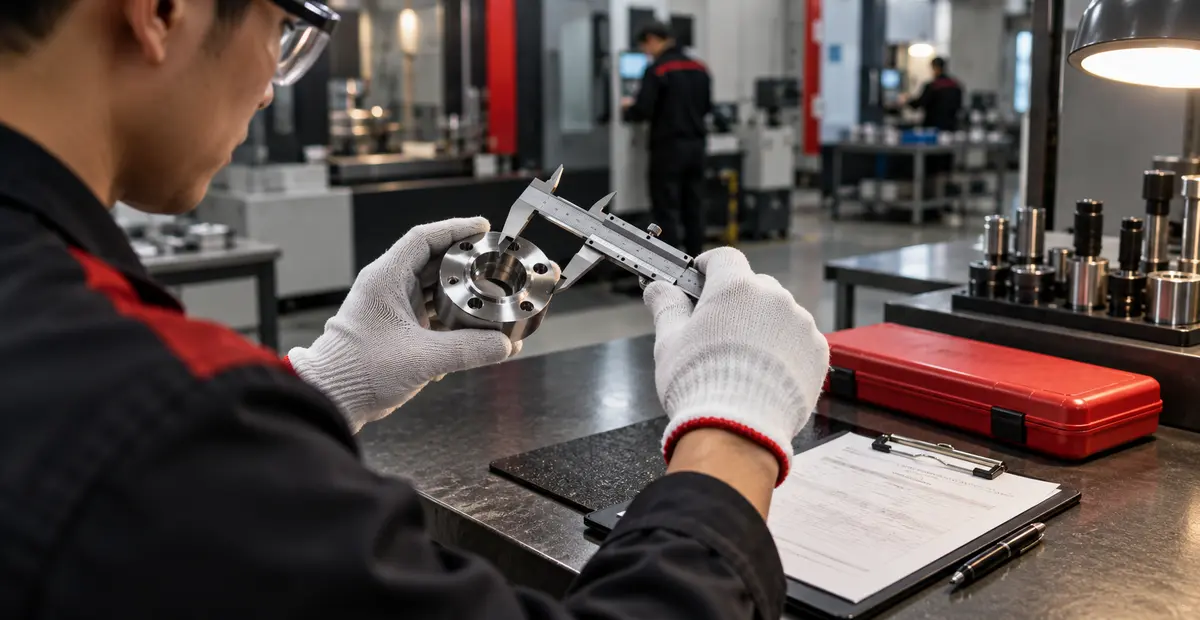
Before sampling, specify what will be measured and what result is acceptable. A manufactured component may require material, dimensional, tolerance and coating checks. A consumer product may raise different performance, packaging or shelf life questions. Testing should match the actual application.
Assign the sample an identifier, record the specification revision and document approval or rejection. Reference that same record in the order. For shipment inspection, agree the sampling plan, defect definitions and acceptance or rejection criteria in advance. One fixed sampling percentage is not suitable for every product.
6. Confirm payment instructions through a second channel
Before every payment, check the beneficiary, account details and their connection to the contract. If instructions change, do not verify the change solely by replying to the message that announced it. Use an established official channel that was independently confirmed.
An unrelated personal account or different beneficiary is a reason to pause and investigate. If an intermediary or affiliated company is involved, document the legal relationship and basis for receiving funds, and have the arrangement checked by the authorised provider. A seller’s urgency should not replace verification.
7. Put responsibilities in writing before ordering
A short pro forma invoice may not address foreseeable disputes. Depending on the transaction, the contract or purchase order should identify the goods and specification revision, quantity, deadline, delivery location, payment milestones, inspection and treatment of defects or shortages. The governing law and dispute mechanism also require assessment appropriate to the parties.
A useful commercial contract framework answers operational questions: Who pays for correction? How long does the buyer have to report a discrepancy? What response is agreed for delay? What evidence releases the next payment? A written clause does not automatically make enforcement easy; evaluate practical recourse too.
8. Convert the findings into a decision
Our suggested statuses are “eligible for pilot order assessment”, “more information required” and “stop”. Verified identity and an acceptable sample may justify examining a pilot order. An unexplained beneficiary or refusal to clarify the legal entity needs resolution before proceeding.
Hypothetical example: a supplier provides a good sample but sends another person’s account on payment day. A strong sample result does not resolve the account issue. Pause payment, obtain documented clarification through an independent channel and reconsider only when the relationship and lawful payment feasibility are established.
For an Iran destination, the product, parties, end use and route also belong in the review. OFAC’s Iran resources should be considered alongside other applicable requirements. Registration does not mean a company is eligible to perform every transaction.
Frequently asked questions
Is a long trading history or platform badge enough?
No. Check the scope of the badge and add legal identity, product specifications and operational evidence. An established seller may still be unsuitable for your particular purchase.
Is an on site visit always necessary?
The depth of review depends on risk. A small standard purchase may justify a narrower assessment, while dedicated tooling, a substantial advance or sensitive quality requirements call for stronger evidence.
Should an existing supplier be checked again?
Yes, particularly after changes to payment details, ownership, production location, materials or order size. Previous successful deliveries are useful evidence but do not resolve new changes.
Prepare the file before final negotiations
Collect the product specification, seller details, quotation and available documents. Contact Simorgh Sorkh to discuss the review scope. For initial candidate identification, explore international sourcing services. Our sourcing country selection guide and Turkey to Iran purchasing guide complement this checklist.